The World Famous Dunn's River Falls & Park
A travertine staircase that ends on a Caribbean beach, and a park built round it for the people who would rather not climb.
The numbersA travertine staircase about 180 feet high and 600 feet long
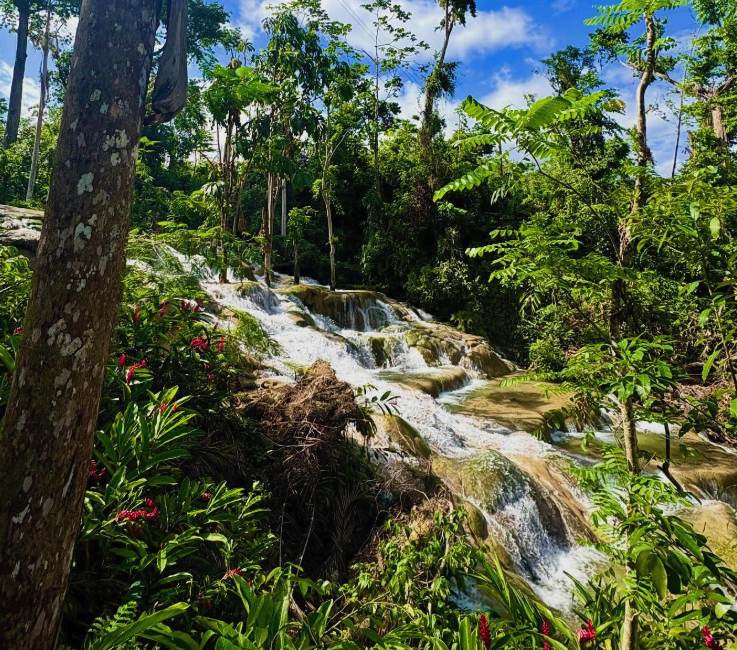
The falls climb roughly 180 feet in height over a run of about 600 feet of terraced rock. That second number is the one that matters on the day, because the run is what you actually climb — a wide, shallow staircase rather than a single drop.
Published figures disagree, and it is worth knowing why before you read them elsewhere.
| Source | Published figure | What it means |
|---|---|---|
| Wikipedia | 180 ft (55 m) high, 600 ft (180 m) long | Height and run given separately — the clearest of the three |
| The park's own site | “more than 183 metres or 960 feet” | 183 metres is 600 feet, so the imperial conversion has slipped |
| The Jamaica Tourist Board | “over 900 feet” | The same slip, repeated |
Nobody is inventing anything; a metric figure was converted wrongly once and has been copied since. Read 600 feet as the length of the climb and you will not be surprised by what you find at the gate.
Why the terraces keep rebuilding themselves
Dunn's River is a travertine waterfall. The spring water feeding it carries dissolved calcium carbonate, and where the water breaks and aerates, that mineral drops out and hardens onto the rock as tufa.
The result is a staircase that grows. Geologists describe formations like this as living, because the sediment is continuously rebuilding the tiers even as the river wears them down. The footholds you use are, in a slow sense, newer than the river.
The one waterfall that runs straight into the Caribbean
Most waterfalls end in a pool, a river or a gorge. Dunn's River is among the very few travertine falls anywhere that empties directly into the sea, spilling across white sand at the western edge of its own beach.
It is the reason the climb finishes the way it does: you come off the last tier, walk a few paces, and you are in salt water. No transfer, no second location.
The climb, and the dry stairway beside it
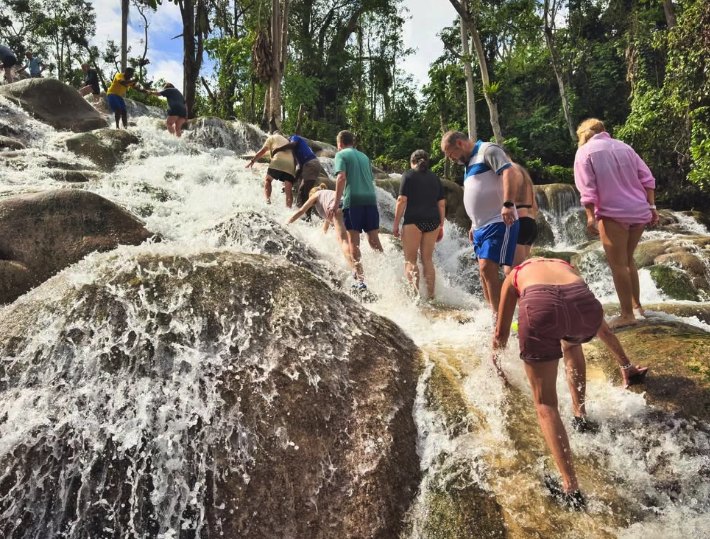
How it works: guides form climbers into a linked chain, hand in hand, and lead from the front. The chain sets the pace, picks the footholds and stops in the wide pools between tiers.
How long it takes: about an hour and a quarter at a steady pace, longer with a large or cautious group.
What it demands: a moderate level of fitness and shoes that grip. It is a scramble over wet rock, not a hike, and the main path is scrubbed of algae.
The way out: a dry stairway runs the full height alongside the water. You can step onto it at any point, and anyone not climbing can follow the group up it and meet them at the top.
Climbing it with a guide
Guided climbs run from Ocho Rios, Montego Bay, Falmouth and Runaway Bay, from From $51 per person with the gate fee included.
The beach at the foot of the falls
The cascade lands on a lifeguarded white-sand beach, and that is where most visitors spend the half hour after the climb. The water is shallow and calm close in, which makes it usable for children who have just been carried up the terraces.
Snorkelling off the sand is possible on a calm day, though the reef trips that sail from Ocho Rios reach better water.
The splash pad, and the park for people who are not climbing
Kiddie splash pad: a shallow, supervised play area for children too small for the terraces — the single most useful thing in the park for a family split between climbers and non-climbers.
Picnic ground: shaded tables set back from the beach.
The stairway: a full-height dry route with viewpoints over each tier, so nobody has to sit in the car park.
Accessible entry: the park publishes barrier-free restrooms and an accessible entrance. The climb is not accessible, and the flat parts of the park are where an accessible visit happens.
The craft market, the shops and the food stalls
A craft market sits inside the grounds, alongside shops selling the two things people forget: water shoes and waterproof phone cases. Buying shoes at the gate costs a little more than buying them in town, and a great deal less than a fall.
Food and snack vendors operate on site. Whether lunch is included depends entirely on the trip you book — the combinations from Montego Bay usually stop at a jerk eatery where you pay your own way.
Lockers, changing rooms and the nurse's station
| Facility | Where | Cost | Worth knowing |
|---|---|---|---|
| Lockers | Beside the changing rooms, near the entrance | About US$10, roughly US$3 refunded on the key | Use one rather than carrying a dry phone up |
| Changing rooms | Near the entrance | Included | Arrive in your swimsuit and you will barely need them |
| Restrooms | Entrance and beach | Included | Barrier-free facilities are published |
| Nurse's station | Inside the grounds | Included | Staffed during opening hours |
| Car and bus parking | Off the main coast road | On site | Straightforward if you have hired a car |
| Jetty | At the beach | — | How the catamaran trips arrive |
For opening hours and what admission costs, see Plan Your Visit. Things to Do covers the activities beyond the climb, and the history page explains how a Spanish name for “the waterfalls” became Ocho Rios. Compare every departure on Dunn's River Falls Tours, or jump straight to a Blue Hole and Dunn's River Falls tour.