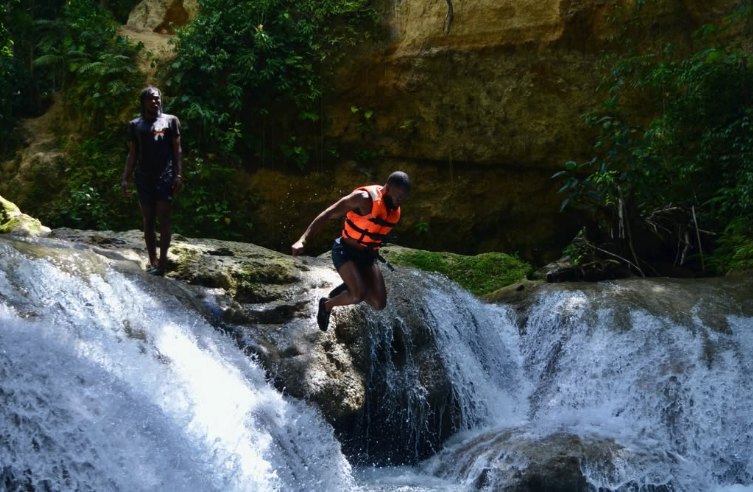
The short answer
They are not variations on the same thing. Dunn's River Falls is wide, shallow and horizontal — you climb up it in a guided chain. The Blue Hole is deep, cold and vertical — you jump into it. Dunn's River is busier and more famous; the Blue Hole is more adventurous. Most trips do both, and doing both is usually the right call.
Two waterfalls, compared
| Dunn's River Falls | The Blue Hole | |
|---|---|---|
| What it is | Terraced travertine cascade ending on a beach | Spring-fed pools in a limestone gorge |
| What you do | Climb up it, guided, in a linked chain | Jump in, swing in, swim |
| Where | Coast road just west of Ocho Rios | About 20 minutes inland from Ocho Rios |
| Time needed | 75 minutes to two hours | About one hour |
| Crowds | Jamaica's most visited attraction | Busy, but a fraction of the falls |
| Water | Warm, ankle to waist deep | Cold, and genuinely deep |
| Facilities | Beach, splash pad, craft market, lockers, nurse | Basic — changing area and a car park |
| Suits | Almost everyone, including nervous climbers | Confident swimmers who like heights |
Dunn's River Falls: wide, shallow, horizontal
The famous one, and famous for a reason. About 600 feet of terraced rock rising roughly 180 feet, ending on a white-sand beach where the river runs straight into the Caribbean — one of very few waterfalls anywhere that does.
You climb it rather than look at it. Guides link the group hand to hand and lead from the front, stopping in the flat pools between tiers. It is a scramble, not a hike, and the climb in detail covers what each section feels like.
What you also get is infrastructure: lifeguards, lockers, changing rooms, a nurse, a splash pad for small children and a craft market. For a family with a wide age range that matters, and the park page lists all of it.
The Blue Hole: deep, cold, vertical
Twenty minutes inland, in a limestone gorge above Ocho Rios, a chain of spring-fed pools sits under the jungle canopy. The water is startlingly blue and startlingly cold after the coast.
The activity is the opposite of the falls. A local guide walks you up the sequence and shows you which ledges are safe to jump from and how deep the water beneath each one is. There is a rope swing over the main pool and a ladder to get out of it.
Nothing is compulsory. Plenty of people spend the hour swimming and jump nothing at all, and the guides are relaxed about it. But if jumping off things into water is your idea of a good afternoon, this is where you will have it.
Which is busier, and does it matter?
Dunn's River draws in the region of a million visitors a year and is Jamaica's most visited attraction. On a cruise-ship morning the terraces are full and the chain moves slowly.
The Blue Hole is busy too, but on a different scale, and it absorbs people better because the pools are spread up a gorge rather than concentrated on one staircase.
This is the single strongest argument for an early departure. Get the falls done before the coaches land, and the Blue Hole afterwards, and you have effectively dodged the crowd twice. The timing detail is here.
If you can only do one
- First time in Jamaica — Dunn's River. It is the image of the island for a reason, and you will regret skipping it.
- Travelling with young children or a mixed-mobility group — Dunn's River, without question. The splash pad, the beach and the dry stairway give everyone something.
- Been before, or you want adventure over the icon — the Blue Hole. It is the more exciting hour.
- Nervous about heights or deep water — Dunn's River. Waist deep at most, and guided the whole way.
- Short on time from Ocho Rios — Dunn's River, and keep the afternoon.
Why almost every trip does both
Because they are twenty minutes apart, they take about an hour each, and they are completely different experiences. A combination departure covers both gate fees and the drive between them, which is close to always cheaper than arranging the two separately.
From Ocho Rios that combination runs four to five hours. From Falmouth it runs five. From Montego Bay the full-day version adds Secret Falls as well and takes eight. The trade-off is simply how far you are starting from — the drive from Montego Bay sets that out.
One practical note: heavy rain occasionally closes the swimming holes when the coast is fine. If that happens the operator offers another date or a refund, and your own 24-hour cancellation right applies regardless.
What each one costs to get into
Dunn's River Falls charges about US$25 for an adult and US$17 for a child aged 4 to 12, with a separate lower rate for Jamaican residents holding local identification. The full breakdown sits on Plan Your Visit.
The Blue Hole charges its own entry at its own gate, and it is not part of the park admission. Two attractions, two fees, two car parks — which is precisely why combination departures exist and why they usually undercut doing it yourself.
Almost every combination folds both gates into one fare. Where a fare excludes an entry it says so, and the comparison table listing the best Dunn's River Falls tour for each departure point shows which is which.
Secret Falls, the third one nobody mentions first
Secret Falls sits a short jungle walk from the Blue Hole and appears on the full-day combination out of Montego Bay. It is smaller, greener and considerably quieter than either of the other two.
Nobody travels to Jamaica for Secret Falls alone. As the third stop on a day that already includes the other two it is a genuine bonus, and it is the one most people end up photographing most. The Montego Bay day explains how the three fit together in eight hours.
Doing both, and what order they come in
Almost every combination visits the Blue Hole first and Dunn's River second, and that order is deliberate. The inland pools are quietest in the morning, and finishing at the coast means you end the day on a beach rather than in a gorge.
It also means the harder swimming happens while everyone is fresh. By the time you reach the terraces you have already been in the water for an hour, which takes the edge off the cold-shock moment that catches people who start at the falls.
The one exception is a cruise day with a tight all-aboard time, where some operators reverse it to guarantee the famous stop happens. If that matters to you, ask when you book — the FAQs cover pier timings.
Do both in an afternoon. The Ocho Rios combination covers the Blue Hole and Dunn's River Falls in four to five hours from From $89, with both gate fees inside the fare. If only the falls appeal, the falls-only trip gives you two hours on the terraces instead. Both are on Dunn's River Falls Tours, and Things to Do covers the rest of the day.