The short answer
The climb is a guided scramble up about 600 feet of wet, terraced limestone, rising roughly 180 feet in total. It takes about 75 minutes in a linked human chain, it needs water shoes and moderate fitness rather than any real skill, and a dry stairway runs the whole height beside it if you want out at any point.
What the climb actually is
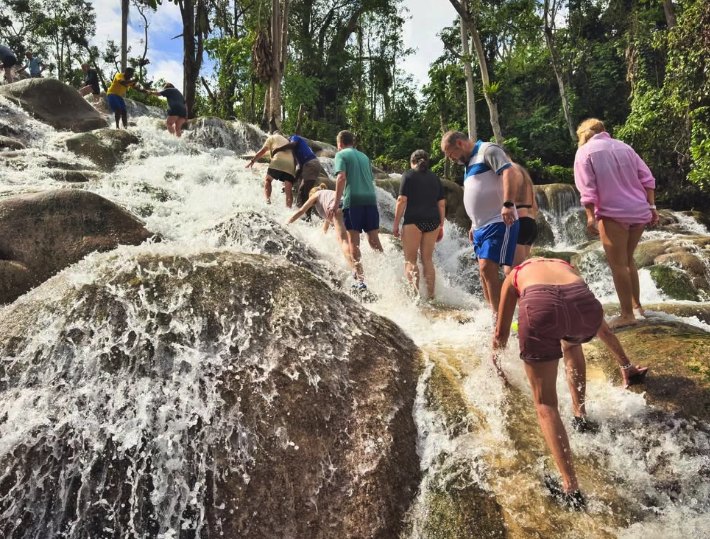
People arrive expecting a waterfall and find a staircase. Dunn's River Falls does not drop in a single sheet; it steps down in wide travertine tiers, most of them shin to waist deep, with flat pools between them where the whole group stops.
That shape is why it can be climbed at all. A 180-foot vertical drop would be a spectacle. A 180-foot rise spread over 600 feet of terraces is a scramble, and one that thousands of people complete every day of the year.
The rock is not slick the way wet stone usually is. Travertine is porous and grippy, and the main route is scrubbed of algae regularly. It is the reason the climb feels safer under your feet than it looks from the beach.
The human chain, and why it works
Falls guides link climbers hand to hand into a chain and lead from the front. It looks like theatre in the photographs. It is not: the chain distributes balance, so a slip becomes a wobble rather than a fall, and it forces a pace slow enough for the least confident person in the line.
Your guide walks the route ahead of you and says where to put each foot. Follow that and the climb is largely solved. The people who struggle are usually the ones who break off to find their own line.
Guides are stationed along the terraces and their help comes with your admission, not as an extra. Gratuities, though, are excluded from every fare, and the guides work for them — carry small notes. What to bring and how to pay covers the practical side.
Tier by tier: what 600 feet feels like
| Stage | What it is | How it feels |
|---|---|---|
| The beach start | Shallow run-out where the river meets the sea | Ankle deep, warm, easy — this is where the chain forms |
| First third | Broad low steps, plenty of grip | The steepest learning curve; most nerves settle here |
| The pools | Flat basins between tiers | Waist deep, still, and where every photograph gets taken |
| Middle section | Taller steps, more water pushing | The physical part — a hand up from the chain is normal |
| Final third | Narrower channels, jungle closing in | Cooler, shaded, and noticeably quieter |
| The top | Exit onto the path | About 75 minutes after you started |
What you need on your feet
This is the one piece of equipment that matters, and the one most people get wrong.
- Water shoes — the right answer. Closed toe, rubber sole, snug fit.
- Sturdy sandals with a heel strap — fine. They stay on.
- Old trainers you do not mind soaking — also fine, and better than nothing.
- Flip-flops — no. They come off in the current and you will spend the climb retrieving them.
- Bare feet — no. The tufa is grippy but sharp in places.
The stairway beside the water — the way out
A dry set of steps runs the full height of the falls, immediately alongside the climb. This matters more than any other single fact about Dunn's River.
You can step onto it at any tier. If the middle section is harder than you expected, or a child has had enough, or you simply want to photograph the group rather than be in it, the exit is right there and it costs nothing to take.
It also means a non-climbing member of your party is not stuck in the car park. They can follow the whole ascent from the side, take the photographs nobody else can, and meet everyone at the top. Families regularly split this way and it works.
How long it takes, and how tired you will be
About 75 minutes from beach to top at a steady group pace. A large or cautious group runs closer to 90 minutes; a small confident one can do it in an hour.
Physically it sits somewhere between a brisk walk and a gentle hike. You will use your hands. You will be wet through. You will not need to be an athlete, and the operators ask for a moderate level of fitness rather than anything more.
Where you feel it afterwards is usually your thighs, from stepping up repeatedly, and occasionally your forearms. It is not a day that requires a recovery day.
Who finds it hard, and what to do about it
The climb does not suit everyone, and knowing that in advance is what lets you plan a good day rather than a frustrating one.
- Back or knee problems — every departure flags this. The stairway is the answer, and the beach and pools are reachable without climbing.
- Wheelchair users — the climb is not accessible. The park publishes barrier-free restrooms and an accessible entrance, and the flat parts of the grounds are genuinely pleasant.
- Very young children — the kiddie splash pad exists for exactly this, and going with children covers ages departure by departure.
- Non-swimmers — the climb is waist deep at most and guided. Tell your guide and you will be kept to the shallow line.
Photographs: the paid package, and your own phone
Photographers work the terraces and sell a package on the way out, usually around US$40. The pictures are often good, taken from angles you cannot reach yourself.
Delivery is the weak point. If you buy one, check the files arrive before you leave the park and keep the receipt. The cheaper and more reliable route is a waterproof case for your own phone, sold at the same shops as the water shoes, with your guide happy to take the group shot at every pool.
Whatever you do, do not carry a dry phone up. Use a locker — about US$10, with roughly US$3 back on the key.
Where the climb starts, and how the day is timed
Every guided departure lands you in the same place: the car park above the beach, then down past the changing rooms and lockers to the sand. The chain forms in the shallow run-out where the river meets the sea, and that is where your guide introduces themselves and asks who is nervous.
Arrive before the coaches and the whole thing changes character. Gates open at 8:30, the first excursion groups reach the terraces around 9:30, and the crowd peaks through late morning. A nine o'clock climb is a short chain moving freely; a half-eleven one on a cruise day is a queue. The timing detail is worth two minutes before you pick a date.
Coming by ship? Take the earliest departure offered rather than the most convenient one. Staying on the island? Check whether ships are alongside at Ocho Rios before choosing your day. Either way a booked departure handles the timing for you, and every Dunn's River Falls guided tours refund in full up to 24 hours ahead if the plan changes.
After the top: the beach, and the rest of the visit
The climb ends on a path at the head of the falls, and a short walk brings you back down to the beach. Most people swim, dry off and browse the craft market, which fills another half hour comfortably.
If you have time, going up a second time costs nothing and is far easier than the first — you know the route, and the chain is usually shorter later in the day. The falls-only trip from Ocho Rios gives two hours on site, which is enough for exactly that. Things to Do covers what else fills an Ocho Rios afternoon, and the beach is included in your admission either way.
Ready to climb it? The falls-only trip from Ocho Rios gives two hours on the terraces from From $51 with admission included — the longest time on site of any departure. Compare it against the Blue Hole combinations on Dunn's River Falls Tours, or read what to bring before you go.