In this guide
- Does the falls run all year?
- How the water level changes
- Is the climb harder when the river is high?
- How cold is the water?
- The year, season by season
- When is the sea calm enough for a boat day?
- When does the Blue Hole get rescheduled?
- What heavy rain actually stops
- Hurricane season and the cancellation window
- Cruise season, and what it changes
- The holiday peaks
- What to book in the dry months
- What to book in the wet months
Does Dunn's River Falls run all year?
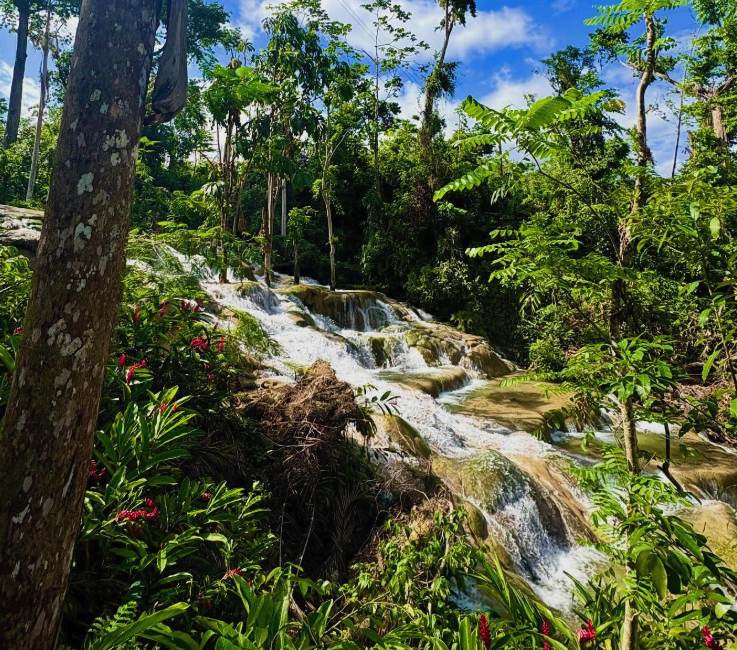
It does, and it never closes for weather. The terraces are fed by a spring-fed river that carries calcium-rich water down to the sea, and the flow continues through the driest months of the year.
What changes between February and October is how hard the water pushes, how green the gorge looks, and how reliable the sea and the inland roads are. The park itself keeps the same hours in every month: 8:30 to 4:00, seven days a week.
So the seasonal question here is not whether you can go. It is which kind of trip suits the conditions you will meet.
How much does the water level change?
Noticeably, but not dramatically. The spring feeding the falls is steady, and the river rises with the rains rather than depending on them. September and October carry the strongest flow; February and March the gentlest.
High water makes the cascade louder, the pools deeper and the photographs better. It also pushes harder against your legs on the steeper tiers, which is worth knowing rather than worrying about.
The rock underneath does not change. Travertine terraces rebuild themselves continuously as the water deposits minerals, which is why the formation is described as a living one and why the climbing line stays broadly the same year to year.
Is the climb harder when the river is high?
A little, in two specific places: the steeper mid-section, where the flow is strongest, and the first tier from the beach, where the water fans out widest.
The guided chain is exactly the answer to that. Groups are linked hand to hand and led along a line the guides choose for the day's conditions, so a stronger flow changes the route rather than the difficulty.
If you would rather see it before committing, the dry stairway runs the full height beside the falls and you can join or leave the climb at several points. What the climb involves, tier by tier, is set out in the guide to the climb.
How cold is the water?
Cool rather than cold, and cooler than the sea beside it. The river is spring-fed and mountain-cooled, so it stays fresh even in August when the Caribbean off the beach is warm enough to feel like a bath.
Most people find the first few steps bracing and forget about it within a minute of climbing. Children generally take it better than adults do.
The Blue Hole inland is a different matter: those pools are deeper, shaded and genuinely cold all year, which is part of why they feel like an adventure rather than a swim.
The year, season by season
| Season | Water level and flow | Sea state | What gets disrupted | What to book |
|---|---|---|---|---|
| December–February | Steady and clear | Calmest of the year | Little | Boat days, and an early start to beat the ships |
| March–April | Steady, water warming | Calm | Little | Anything — the most reliable window of the year |
| May–June | Rising after the first showers | Mostly calm | Short afternoon showers | Inland combinations; the gorge is at its greenest |
| July–August | Moderate, warm | Warm and generally calm | Heat rather than weather | Early departures, and anything with shade or water |
| September–October | Highest and fastest | Least reliable | Tropical systems; occasional Blue Hole closures | A falls-only run, booked late |
| November | Falling back | Settling | Tail of the season | Combinations, as the cruise ships return |
The climb runs year round. What the seasons change is the water, the sea and the inland roads — not whether the park is open.
When is the sea calm enough for a boat day?
December to April is the most reliable stretch, and that is when the catamarans run fullest. The north coast is sheltered enough for the crossing to be comfortable most of the year, but swell builds in the late summer and autumn.
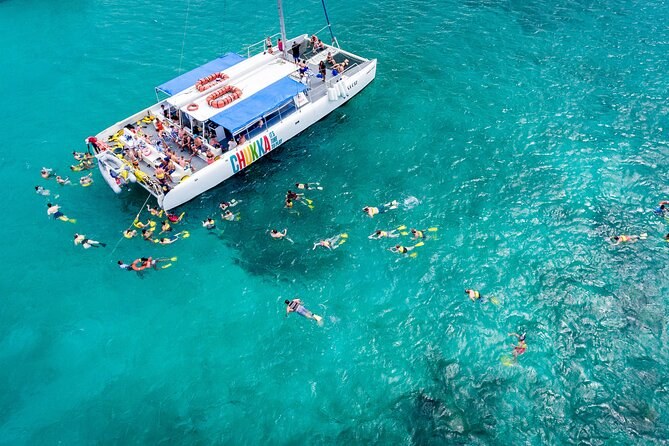
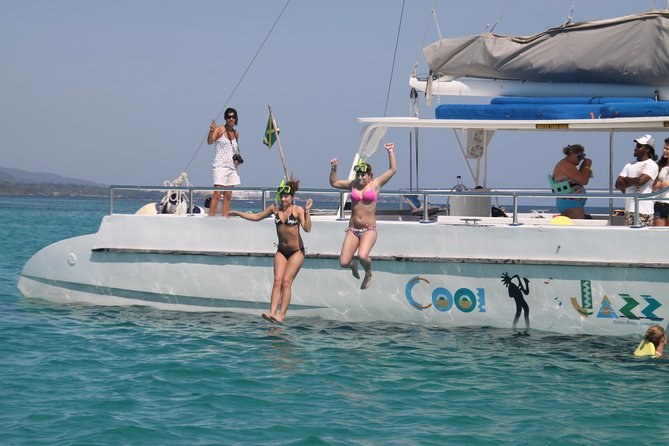
Boat days are the products the weather actually governs. Both the catamaran cruise and the party cruise sail west along the coast, stop over a reef to snorkel, and land passengers for the climb, and every part of that works better on a settled sea.
If your trip falls between September and early November and a boat day is the plan, book it early in your stay rather than late. That leaves room to move it inside the free-cancellation window if the forecast turns.
When does the Blue Hole get rescheduled?
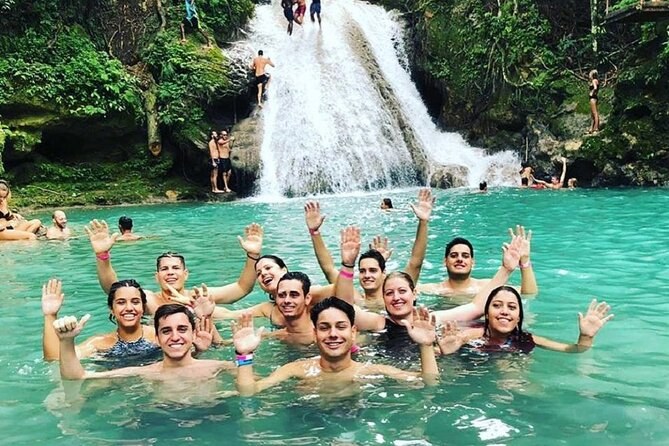
After heavy inland rain, which is most likely between September and November. The pools sit in a gorge fed by the same rains that swell the falls, and the operators close the jumping platforms when the water is high and fast.
When that happens on a combination trip the operator offers another date or a full refund. It is a rescheduling question rather than a lost-money one, and the twenty-four-hour cancellation window sits underneath it.
The practical move is to book the combination for early in your stay, so a weather day has somewhere to move to. What each of the two waterfalls offers is compared in the Blue Hole comparison.
What does heavy rain actually stop?
Very little at the falls, and rather more on the road. You are climbing through moving water already, so a shower on the terraces changes nothing except the photographs — and the gorge is at its greenest in the wet months.
What rain affects is the inland drive to the Blue Hole, which slows on the mountain roads, and the sea crossing on a boat day. Both are recoverable; the climb is not usually at risk at all.
Bring a dry bag for the phone and treat rain as a crowd-thinner rather than a problem. Wet afternoons are among the quietest hours the terraces get.
What about hurricane season?
The Atlantic hurricane season runs June to November, with the highest risk from late August through October. Direct effects on any given week are unlikely, but tropical systems do move travel plans around.
This is the situation free cancellation exists for. Every departure refunds in full up to twenty-four hours before the start time, so booking in advance during hurricane season costs nothing if the weather turns, and it holds the slot that fills first if it does not.
Book the water-dependent trips — the boat days and the Blue Hole combinations — for the first half of your stay in those months. That is the whole strategy, and it works.
When is cruise season, and what does it change?
Roughly November to April, peaking between January and March. Cruise calls do not change the waterfall, but they change how many people are on it at eleven in the morning, and they change what is bookable.
More ships mean more excursion departures, more pier-collection trips from Falmouth, and fuller morning slots. On days when ships are alongside at Ocho Rios the park opens at seven rather than 8:30, specifically to spread the arrivals.
The crowd calendar, the quietest hours and how to read the ship schedule are set out on the best time to visit. The short version for booking: take the earliest departure offered.
When are the holiday peaks?
Christmas through the first week of January, Easter week, and the American spring-break stretch in March. Those are the periods when morning departures sell out days in advance rather than hours.
July and August bring a second peak of a different kind: family holidays rather than cruise traffic, warmer water, and a park where the splash pad and the beach carry as much weight as the climb.
Outside those windows a few days' notice is enough for almost any departure.
What should you book in the dry months?
Anything, and preferably something on the water. December to April gives the calmest sea and the most settled inland roads, which is exactly when a catamaran day or a Blue Hole combination delivers everything it promises.
Book early in the day and early in the season. This is peak cruise season as well as peak tourist season, so the morning slots that dodge the coaches are the first to go.
What should you book in the wet months?
Something short, inland and flexible. A falls-only run is close to weatherproof: the drive is short, the climb is unaffected, and the terraces are at their quietest of the year in September and October.
Keep the boat days and the multi-stop combinations for the first half of the stay so there is room to move them. And book them anyway — the refund window means an unused reservation costs nothing, while an unbooked morning in a quiet month still needs a driver.
Frequently asked questions
What is the best time of year to visit Dunn's River Falls?
Does Dunn's River Falls close when it rains?
Is the climb harder in the rainy season?
How cold is the water at Dunn's River Falls?
Should I book during hurricane season?
When is the water at its highest?
Trips shaped by the conditions
Two boat days for calm water and settled weather, and a shorter inland run for the months when the sea is not playing.